






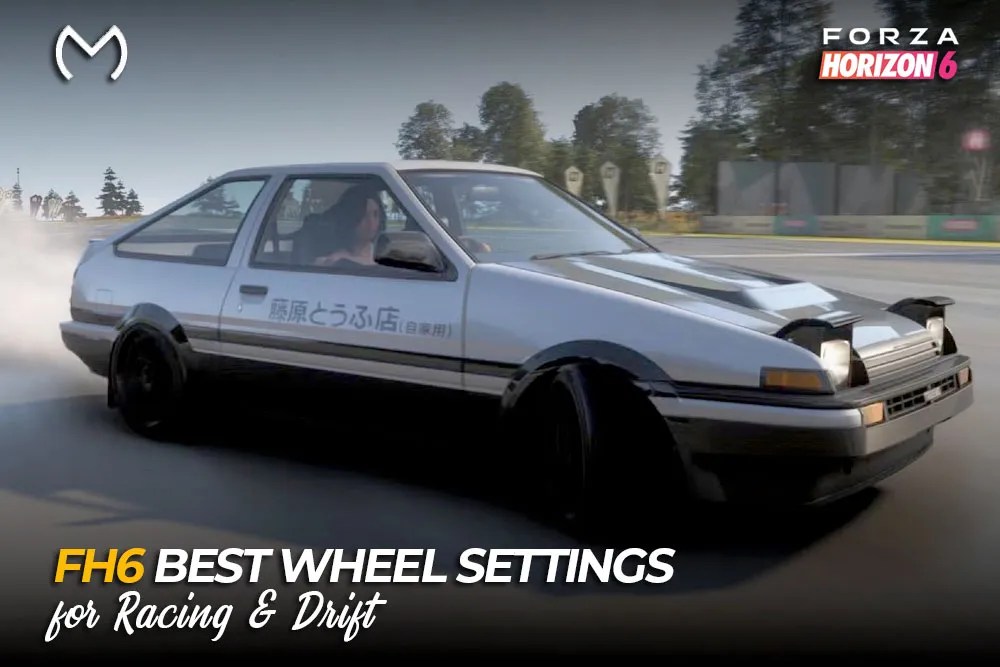
The Forza Horizon 6 best wheel settings should let you feel what the car is doing without making every corner feel like an arm workout. You want clear tyre feedback, quick steering, and enough control to catch the rear when it starts sliding.
Start with these values, run a few races, and only change the settings that do not feel right on your wheel.
Best FH6 Wheel Settings
| Setting | Recommended Value |
| Steering | Simulation |
| Wheel Rotation | 720° |
| Steering Dead Zone Inside | 0 |
| Steering Dead Zone Outside | 100 |
| Steering Linearity | 50 |
| Force Feedback Scale | 0.8–1.0 |
| Center Spring Scale | 0.5–0.8 |
| Wheel Damper Scale | 0.0–0.4 |
| Mechanical Trail Scale | 0.9–1.0 |
| Minimum Force | 0.8–1.0 |
| Road Feel Scale | 0.5–0.8 |
| Load Sensitivity | 0.8–1.0 |
These values are a solid starting point, not a perfect preset for every setup. A Logitech G29 feels nothing like a Fanatec or MOZA direct-drive wheel, so expect to make a few small changes.
Set Up the Wheel First
Before changing sliders, update your wheel firmware and software. Logitech users should check G Hub, while Thrustmaster, Fanatec, and MOZA users should update their wheelbase software.
Then:
- Plug the wheelbase directly into the PC or console.
- Unplug controllers and USB devices you are not using.
- Create a custom wheel profile in Advanced Controls.
- Test steering, throttle, brake, clutch, and handbrake.
- Start with the defaults recommended in Forza Support’s advanced wheel tuning guide, then change one setting at a time.
FH6 sends force feedback to the device listed as Device 1. If a controller, shifter, handbrake, or separate pedal set connects first, the wheel may still steer but give you no FFB.
Steam can also load the wrong input profile. The same checks used when a controller is not working in FH6 on Steam can clear bad mappings before you set up the wheel again.
Best Steering Rotation
For most players, 720° is the sweet spot. It feels smooth on faster roads but still turns quickly enough for tight corners and city racing.
- 540°–720°: Drifting and quicker counter-steering
- 720°–900°: Grip racing
- 900°: Cruising and rally driving
If the car feels nervous around the centre, raise the rotation. If you cannot catch a slide quickly enough, lower it.
Keep Steering Dead Zone Inside at 0 unless the car moves while the wheel is centred. Leave the outside value at 100 so the game reads the full steering range.
Steering Linearity at 50 gives you a clean response. Lower values make the centre sharper, while higher values calm down small steering movements.
Force Feedback Settings
Force Feedback Scale controls the overall strength. Turning it up too far causes clipping, so every strong force starts feeling the same and smaller tyre details disappear.
Center Spring pulls the wheel back toward the middle. Lower it if the wheel feels heavy, especially in slow corners.
Wheel Damper adds resistance. A little can calm a strong direct-drive base, but too much makes the wheel feel sticky and slow.
Mechanical Trail creates the pull that brings the wheel back as the tires regain grip. Keep it strong enough to feel the car straighten without hiding understeer.
Road Feel adds kerbs, gravel, dirt, and rough tarmac. If the wheel rattles over every tiny bump, bring this setting down.
When steering feels delayed during frame drops or stuttering, sort out the FH6 graphics settings for steadier FPS before changing rotation or sensitivity.
Logitech G29, G920, and G923
Logitech wheels have less torque and more gear noise than belt-driven or direct-drive models.
Start with:
- 540°–720° rotation
- Low or zero Wheel Damper
- Moderate Road Feel
- Force Feedback near default
- Minimum Force high enough to remove the dead feeling in the centre
If the wheel chatters over every bump, lower Road Feel and Minimum Force. If the centre feels empty, raise Minimum Force in small steps.
Thrustmaster Wheel Settings
For the T150, TMX, T248, and T300, start with 720° rotation and keep Force Feedback close to default.
These wheels usually feel smoother than Logitech models, so they can handle slightly more damping. Lower Road Feel if kerbs and gravel are drowning out the grip feedback.
The T300 and similar belt-driven wheels usually feel best with smooth, controlled forces instead of every vibration slider pushed to the top.
Fanatec and MOZA Settings
Fanatec and MOZA direct-drive wheelbases can hit much harder. Start with lower overall strength and add a small amount of damping if the wheel shakes on straights.
Do not chase maximum torque. A slightly lighter setup often makes understeer, tyre slip, and weight transfer much easier to read.
Wheel support also depends on the platform. FH6 crossplay and cross-save connect supported systems, but a wheel built for PC will not always work on Xbox.
After confirming the correct hardware version, Forza Horizon 6 platform and account options remain separate from the wheel setup itself.
Grip Racing vs Drifting
| Driving Style | Rotation | Damper | Mechanical Trail |
| Grip Racing | 720°–900° | Low–Moderate | 0.8–0.9 |
| Drifting | 540°–720° | Low | 0.9–1.1 |
For grip racing, Simulation Steering gives a sharper connection to the front tyres. Smooth throttle and brake inputs matter more than running maximum FFB.
For drifting, lower the rotation and damping so the wheel can spin freely through counter-steer. Try Normal Steering if Simulation feels too sharp and keeps throwing the car into a spin.
Test your wheel across more cars and builds:

Quick Wheel Fixes
- The wheel feels too heavy: Lower FFB, Center Spring, or Damper.
- Wheel shakes on straights: Add a little Damper.
- Steering feels twitchy: Increase the rotation.
- No tyre detail: Lower overall FFB.
- No force feedback: Make sure the wheelbase is Device 1.
- Pedals are reversed: Correct the axis inversion.
- Counter-steering feels slow: Lower rotation and damping.
If the game crashes while wheel software, overlays, and several USB devices are running, test the usual FH6 PC crash fixes before deleting your custom profile.
Final Takeaway
Start with 720° rotation, 50 Linearity, moderate force feedback, and low damping. Then make small changes based on your wheel and whether you prefer grip racing, rallying, cruising, or drifting.
FAQs
Will Forza Horizon 6 be good on a wheel?
Yes. Once the rotation and force feedback feel right, FH6 is smooth, responsive, and much more immersive on a wheel.
What is the best steering angle for Forza?
Start at 720°. Use 540°–720° for drifting or move closer to 900° for smoother racing and cruising.
Is Forza Horizon 6 driving realistic?
FH6 is a simcade racer rather than a full simulator. The handling stays accessible, but grip, braking, weight transfer, and steering still feel believable.
How does Forza Horizon 6 aim to improve player progression?
You can move forward through races, exploration, seasonal events, challenges, and rewards instead of being locked into one path.