






Black Ops 7 recoil control starts with understanding what moves when you fire. Vertical climb, horizontal drift, gun kick, view kick, flinch, and idle sway can all affect how steady a weapon feels, but they do not describe the same mechanic.
Every weapon also behaves differently. Instead of memorizing one rule for an entire class, test the exact gun, attachments, optic, and mode you plan to use.
How Recoil Works in BO7
The Gunsmith separates weapon performance into detailed statistics. The most important recoil-related terms are:
| Recoil Term | What It Means |
|---|---|
| Vertical Recoil | How strongly sustained fire moves upward |
| Horizontal Recoil | How much shots move left or right |
| Recoil Gun Kick | The weapon’s shot-to-shot movement and deviation |
| View Kick | The visible movement of the camera or sight while firing |
| Flinch Resistance | How well your aim holds when incoming fire hits you |
| Aiming Idle Sway | Reticle movement before and between shots |
| Recoil Stabilization | How consistently the weapon settles during fire |
Gun kick and view kick can make a weapon feel unstable even when its overall vertical climb looks manageable.
The official BO7 Gunsmith breakdown shows the Accuracy, Firepower, Mobility, and Handling statistics used to compare attachments.
Players comparing weapons, camos, and progression systems can also browse the current BO7 weapon and progression options.
Are BO7 Recoil Patterns Fixed?
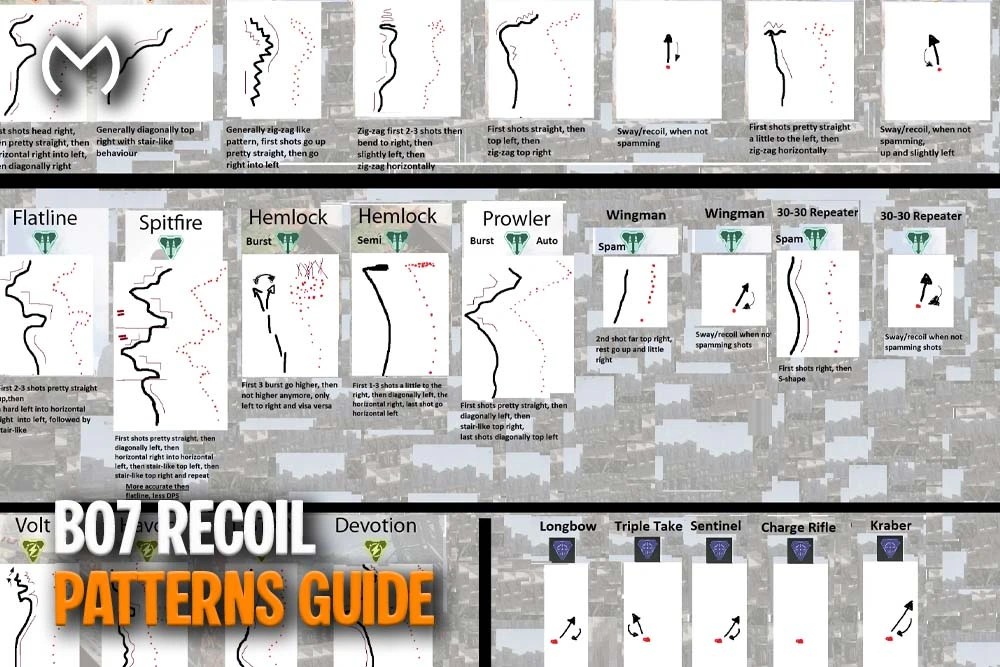
BO7 weapons usually have a recognizable tendency, but the exact bullet path is not perfectly identical in every magazine.
A gun may:
- Climb mainly upward
- Drift toward one side
- Bounce between both sides
- Kick harder on its opening shots
- Become less stable during sustained fire
- Recenter quickly between controlled shots
- Include some random gun-kick or view-kick deviation
Therefore, recoil control is about learning the weapon’s general direction and intensity rather than tracing one perfectly fixed shape.
The previous claim that every weapon settles after six to eight bullets has been removed. Some guns calm down, while others continue climbing or introduce more side-to-side movement.
Different BO7 Weapons Behave Differently
Class labels alone do not reveal a weapon’s recoil pattern.
| Weapon Example | Confirmed Recoil Characteristic |
|---|---|
| M15 MOD 0 | Balanced power, accuracy, and handling |
| AK-27 | Low vertical recoil but high horizontal recoil |
| KRS-7.62 | Significant first-shot recoil with fast recentering |
| Sokol 545 | Lower-rate mode improves accuracy; faster mode adds recoil |
| REV-46 | Folded and unfolded positions change handling and recoil |
| VST | Recent tuning reduced gun kick and view kick |
The AK-27 is a good example of why “pull straight down” is not always enough. Its low vertical climb may feel manageable, but horizontal movement can still push bullets away from the target.
Likewise, the KRS-7.62 needs controlled follow-up timing because its first shot produces significant recoil, even though the rifle recenters quickly afterward.
How to Read a Weapon’s Recoil Pattern
Use the same weapon, optic, attachments, stance, and distance throughout the test.
- Enter the Firing Range or a private match.
- Stand about 10 to 15 metres from a flat wall.
- Aim at one clear point.
- Fire a full magazine without correcting the aim.
- Look for upward climb, sideways drift, and sudden jumps.
- Repeat the test two or three times.
- Add one attachment and test again.
- Move farther away to see how small deviations affect longer shots.
Repeating the test matters because random deviation can make one magazine look slightly different from the next.
The existing beginner combat and settings overview also covers sensitivity, basic aiming practice, movement, and loadout setup.
How to Control Vertical Recoil
For a weapon that climbs upward, apply a smooth downward input as sustained fire begins.
Do not pull down sharply before firing. Starting too early can move the first bullet below the target.
Instead:
- Center the crosshair before aiming
- Fire the first shot on target
- Add gradual downward pressure as the weapon climbs
- Release the counter-input when you stop firing
At longer ranges, use shorter bursts rather than trying to control an entire magazine.
How to Control Horizontal Recoil
Horizontal recoil is harder to counter because side-to-side movement can include inconsistent deviation.
If repeated tests show a clear drift:
- Counter rightward drift with a slight left input
- Counter leftward drift with a slight right input
- Avoid overcorrecting after every individual bullet
- Choose attachments that specifically improve Horizontal Recoil Control
Do not assume every weapon moves right. Test the actual build before developing muscle memory.
Use Burst Fire at Longer Ranges
Burst firing allows the sight to settle before the next group of shots.
A useful rhythm is:
- Fire three to six rounds
- Release the trigger briefly
- Recenter on the target
- Fire the next controlled group
The ideal burst length depends on the weapon. A slow, accurate rifle may support longer bursts, while a high-recoil SMG may need shorter ones beyond its intended range.
Bursting does not always reset recoil instantly, so watch the reticle instead of following one fixed timing rule.
Crosshair Placement Comes Before Recoil Control
Good recoil control cannot rescue poor initial aim.
Keep the crosshair near the height where an opponent’s upper torso or head is likely to appear. This reduces the correction required after the first shot and helps vertical climb remain inside the target.
However, deliberately aiming too low and hoping recoil reaches the head creates inconsistent opening damage. Start on the target, then control the climb.
Does Movement Reduce Recoil?
Strafing does not directly lower Vertical Recoil, Horizontal Recoil, or Gun Kick values.
Movement can still help because it:
- Makes you harder to hit
- Helps track an opponent moving sideways
- Adjusts your angle around cover
- Prevents you from remaining in one predictable position
The trade-off is that you must control both your own movement and the weapon at the same time. Practice stationary recoil first, then add strafing once the counter-input feels natural.
For more focused mechanical practice, the article on deeper recoil-control techniques covers additional aiming and movement drills.
Attachments That Improve Recoil
Do not choose an attachment only because it belongs to a particular category. Read its exact Pros, Cons, and advanced statistics.
| Attachment Area | Possible Recoil Benefit |
|---|---|
| Muzzle | Vertical control, horizontal control, stabilization, or suppression |
| Underbarrel | Horizontal control, vertical control, stabilization, or first-shot control |
| Rear Grip | Handling, recoil control, or flinch resistance |
| Barrel | Range, velocity, first-shot behavior, or general recoil |
| Stock | Aiming movement, stability, handling, or recoil on selected weapons |
| Fire Mod | Recoil tuning, fire-rate conversion, or major pattern changes |
| Prestige Attachment | Weapon-specific improvement with substantial trade-offs |
One muzzle may improve vertical recoil, while another focuses on horizontal control. Similarly, some suppressors improve recoil, but others trade range or velocity for minimap protection.
Check these values before equipping an attachment:
- Recoil Gun Kick
- Horizontal Recoil Control
- Vertical Recoil Control
- Recoil Stabilization
- First-Shot Recoil
- Flinch Resistance
- ADS Speed
- Sprint-to-Fire Time
Adding every recoil attachment can make a weapon accurate but too slow. Use enough control to keep shots on target, then preserve the handling needed for your playstyle.
Recoil Differences Between Weapon Classes
Assault Rifles
ARs usually balance range and control, but their patterns vary considerably. The M15 MOD 0 offers a balanced baseline, while the AK-27 places more pressure on horizontal control.
SMGs
SMGs often fire quickly and fight at closer ranges. Their recoil can feel less punishing up close, although side-to-side movement becomes much more noticeable when challenging distant targets.
Light Machine Guns
LMGs offer sustained fire and large magazines, but they are not universally low recoil. Some become steadier after the opening shots, while others need strong vertical control during long bursts.
Marksman Rifles
Burst and semi-auto rifles depend heavily on first-shot recoil, recentering, and trigger timing. Allow the reticle to settle instead of firing the next shot before the weapon recovers.
Sniper Rifles
Bolt-action weapons do not produce a traditional full-auto spray pattern, but they still have view kick, gun kick, flinch, sway, and rechamber recovery. Those factors affect follow-up accuracy.
Pistols
Pistols range from fast semi-auto sidearms to slower precision builds. Test the trigger rhythm and recentering rather than assuming every pistol has a small vertical pop.
Beginner Recoil Practice Routine
Spend five to ten minutes on one weapon instead of switching guns constantly.
Step 1: Test the Base Weapon
Fire several magazines without attachments. Identify the strongest direction of movement.
Step 2: Add One Recoil Attachment
Test again from the same distance. Compare the grouping rather than relying only on the Gunsmith bar.
Step 3: Practice Counter-Input
Apply smooth downward pressure and correct any consistent sideways drift.
Step 4: Add a Moving Target
Track a bot while maintaining the same recoil-control input.
Step 5: Increase the Range
Move farther back and shorten your bursts when the grouping begins leaving the target.
Step 6: Test the Final Match Build
Repeat the drill with the exact optic, magazine, muzzle, and grip you plan to use. Changing the build can change the pattern.
Controller and Mouse Recoil Tips
Controller
- Set the minimum stick deadzone low enough to respond without causing drift.
- Use gradual right-stick pressure.
- Avoid repeatedly flicking down during sustained fire.
- Let aim assist support target tracking rather than expecting it to cancel recoil.
- Keep sensitivity consistent while building muscle memory.
Mouse and Keyboard
- Use one smooth downward movement instead of several sharp corrections.
- Reset the mouse position after each burst or magazine.
- Keep the same sensitivity while comparing weapons.
- Avoid changing DPI to solve a weapon-specific recoil problem.
- Use the whole available mouse space during longer sprays.
Settings can change how easy recoil feels to control, but they do not remove the gun’s underlying recoil values.
Recoil Changes Across Updates and Modes
Weapon tuning changes throughout the BO7 seasons. A patch may adjust:
- Gun kick
- View kick
- Horizontal or vertical recoil
- Random deviation
- First-shot behavior
- Attachment benefits or penalties
For example, earlier updates reduced harsh gun and view kick on the Ryden 45K, adjusted recoil deviation on the MPC-25, and changed several individual attachment values.
Review the current BO7 weapon-tuning notes before copying an older low-recoil build.
Also test weapons in the mode where you will use them. Multiplayer, Warzone-style modes, Endgame, and Zombies can receive separate tuning or upgrades.
Check out some of our most popular Boosting services:


Recoil Practice and Progression
Better recoil control can help with headshots, long-range eliminations, accuracy-based challenges, and sustained streaks. However, it does not change the challenge requirement itself.
Players chasing hidden precision and streak objectives can review the hidden BO7 Dark Ops requirements separately.
Zombies also uses mode-specific upgrades and difficulty modifiers. The Zombies Cursed Mode Relic modifiers affect those runs but should not be treated as normal Multiplayer recoil attachments.
Players comparing completion options across different camo routes can browse mode-specific camo progression support.
The existing current Call of Duty service catalog remains available for broader account, item, and progression categories.
BO7 Recoil Patterns Guide — Final Thoughts
BO7 recoil patterns have recognizable tendencies, but they are not perfectly fixed lines. Test each weapon, learn whether vertical climb, horizontal movement, first-shot kick, or visual motion causes the main problem, and then choose attachments that target that exact weakness.
Start with smooth counter-input, controlled bursts, and consistent crosshair placement. Once the basic pattern feels natural, add movement and target tracking without changing the build or sensitivity every few matches.
Popular Black Ops 7 Services
[KEEP THE EXISTING FOUR-PRODUCT WIDGET HERE UNCHANGED: SLICK CAMO, NETWORKED CAMO, CALLING CARDS UNLOCK, AND NEON GALLOWS CAMO]
BO7 Recoil Pattern FAQs
Are BO7 recoil patterns completely fixed?
No. Weapons usually have a repeatable general tendency, but gun kick and view kick can contain random deviation. Test several magazines before deciding how a weapon moves.
What is Recoil Gun Kick in Black Ops 7?
Recoil Gun Kick describes the weapon’s shot-to-shot movement and deviation while firing. Lower gun kick generally creates a tighter and more predictable grouping.
What is the difference between vertical and horizontal recoil?
Vertical recoil moves the weapon upward. Horizontal recoil moves shots left or right. Vertical climb is usually easier to counter because a steady downward input can oppose it.
What attachments reduce recoil the most?
It depends on the weapon. Check the advanced statistics for Vertical Recoil Control, Horizontal Recoil Control, Gun Kick, Stabilization, and first-shot recoil rather than choosing attachments by category alone.
Does strafing reduce recoil in BO7?
No. Strafing does not directly reduce the weapon’s recoil statistics. It helps with tracking, positioning, and making yourself harder to hit.
Is burst firing better than full-auto fire?
Burst firing is usually more accurate at longer ranges because it gives the sight time to settle. Full-auto fire remains useful at close range or with a highly controllable build.
Can controller or mouse settings remove recoil?
No setting removes the underlying recoil. Appropriate sensitivity and deadzones can make the counter-input easier and more consistent.
Why does my weapon’s recoil change after an update?
Treyarch can adjust gun kick, view kick, deviation, vertical or horizontal recoil, and individual attachments through balance patches. Re-test the weapon after major updates.