







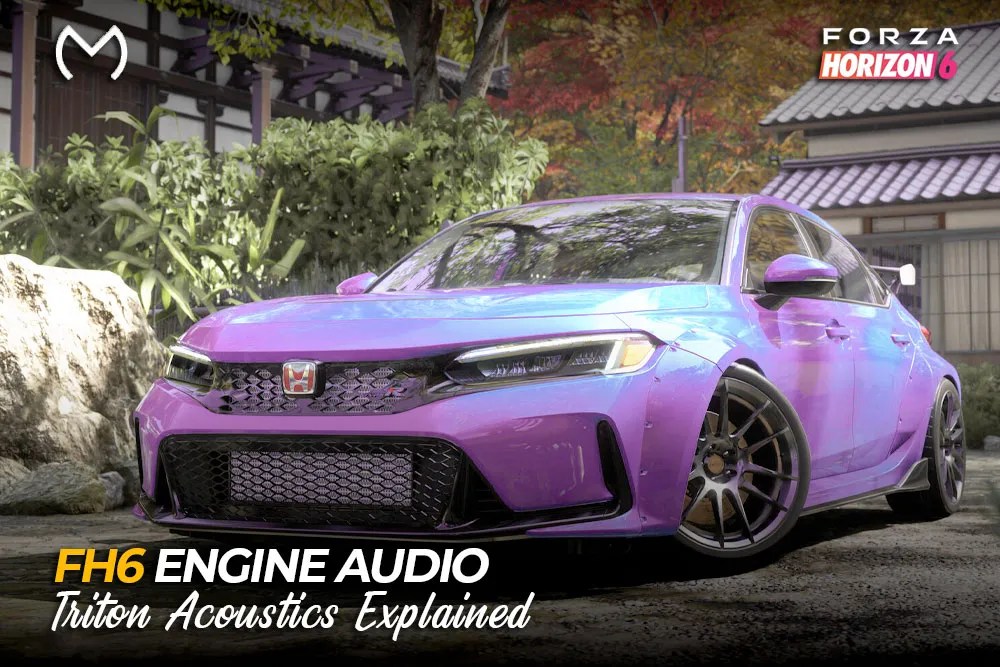
Forza Horizon 6 engine audio uses new recordings, remastered samples, turbo and backfire layers, and Triton Acoustics. The result goes beyond a cleaner engine note.
A car sounds different depending on the road, camera, walls, and surrounding space. Tokyo streets, tunnels, garages, and mountain routes reshape the same source sound in different ways.
How FH6 Builds Each Car’s Sound
The audio mix is assembled from several connected layers.
| Audio layer | What you hear |
| Source recording | Engine note, intake, exhaust, gear changes |
| Modular effects | Turbo spool, supercharger whine, backfire |
| Surface interaction | Asphalt, gravel, water, dirt, and kerbs |
| Triton response | Reverb, muffling, reflections, and distance |
| Output mix | Cockpit, hood, chase camera, stereo, surround |
The official FH6 audio FAQ separates the car’s source audio—new recordings, remastered samples, turbo, and backfire systems—from Triton Acoustics, which generates environmental reverb from virtual object positions.
The move from Forza Horizon 5 to Forza Horizon 6 is easiest to hear in sharper engine notes, richer tyre interaction, and stronger environmental reflections.
What Triton Acoustics Actually Does
Triton is an object-based spatial reverb system. It uses the shape and materials of the game world to decide how sound reflects, fades, bends, or becomes blocked.
Its main effects include:
- Reverberation: reflections continue after the direct sound
- Occlusion: walls or buildings weaken and muffle a source
- Diffraction: sound bends around corners and barriers
- Portaling: openings redirect sound
- Decay time: large spaces hold reflections longer
Much of the simulation can be calculated before gameplay. At runtime, the system reads that data as the car and listener move through the world.
That is why one exhaust note can feel tight inside a garage, sharp in a concrete tunnel, broken between buildings, and cleaner on an open road.
Where the Difference Is Most Noticeable
Use the same car and tune for a simple comparison:
- Drive on an open road with little traffic.
- Enter a tunnel or enclosed parking area.
- Stop beside a wall or building corner.
- Switch between cockpit, hood, and chase cameras.
- Repeat with headphones or surround speakers.
The engine source remains familiar, but the acoustic response changes. Cockpit audio sounds more enclosed, while the chase camera gives the exhaust and reflections more space.
Wheel users often feel engine RPM, tyre load, sound, and force feedback as one response. When vibration disappears after switching between USB, Bluetooth, or Steam Input, restoring FH6 controller vibration becomes a separate input issue rather than an acoustic one.
Triton Acoustics vs Dolby Atmos
The Triton Acoustics and Dolby Atmos do different jobs.
Triton controls how sound behaves inside the virtual environment. It calculates reflections, muffling, diffraction, and distance before the final mix reaches the player.
Dolby Atmos, Windows Sonic, or another spatial-output format places that mix around headphones or speakers. They can work together, but they are not interchangeable.
Best Audio Settings for Clearer Engine Sound
A car-focused mix does not require every slider at maximum.
- Raise the player-car or vehicle sound level
- Lower radio music and dialogue slightly
- Compare cockpit and chase-camera audio
- Use headphones for clearer positional detail
- Avoid stacking virtual-surround processors
Heavy bass or aggressive equalization can hide turbo detail, tyre noise, and distant cars. A balanced mix makes changes in road surface and enclosure easier to hear.
Headphones, surround speakers, controllers, and racing wheels reveal different parts of the same mix. Once the setup is working properly, players choosing how to continue can compare Forza Horizon 6 account and gameplay options separately from audio configuration.
Explore FH6 services for cars, credits, and progression:

Performance and Audio Problems
Triton uses precomputed acoustic data so detailed wave-based effects can run within practical CPU and memory limits. Normal Triton processing is not considered a major standalone FPS penalty.
Crackling, popping, delayed effects, and complete sound loss are not intended occlusion. Fixing FH6 audio crackling usually means checking drivers, sample rates, Bluetooth modes, spatial-audio conflicts, and damaged files.
When audio breakup appears with frame-time spikes, high VRAM use, or unstable city performance, FH6 graphics settings for stable FPS should be adjusted before treating Triton Acoustics as the cause.
Final Takeaway
FH6 separates the car’s recorded sound from the world that reshapes it. New samples define the engine, turbo, exhaust, and backfire character, while Triton Acoustics makes that sound react naturally to tunnels, walls, streets, open roads, camera position, and distance.
FAQs
What is Triton Acoustics in Forza Horizon 6?
It is an object-based spatial reverb system that changes how car and environmental sounds reflect, bend, fade, and become blocked around the game world.
Will Forza Horizon 6 have real car sounds?
Yes. FH6 uses new recordings and remastered vehicle audio, supported by turbo, backfire, tyre, surface, and environmental layers.
How to make your car louder in Forza Horizon 6?
Raise the player-car audio level, lower radio and dialogue volume, and compare cockpit with chase camera. Avoid excessive bass or overlapping virtual-surround effects.
How accurate are the car sounds in Forza Horizon 5?
FH5 used real-vehicle recordings and dynamic processing, but accuracy varied between cars. FH6 builds on that foundation with remastered audio and stronger environmental response.
Does Triton Acoustics affect FPS?
Its expensive wave simulation is largely precomputed, leaving lighter runtime processing. It is not generally treated as a major independent cause of low FPS.