







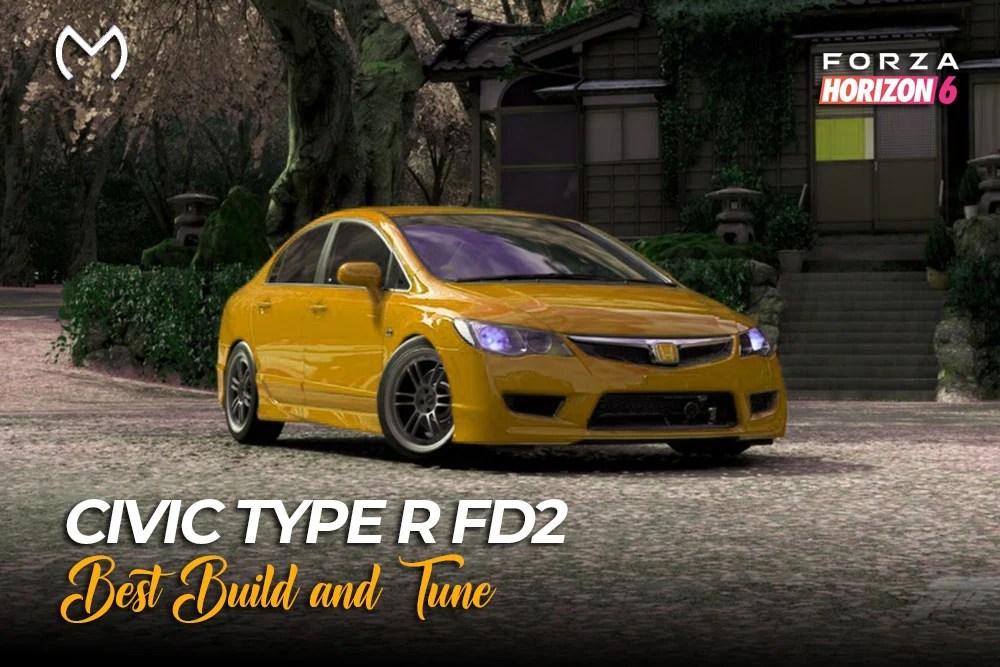
The best Forza Horizon 6 Honda Civic Type R FD2 build keeps the car in A-Class, preserves front-wheel drive and spends Performance Index on grip before power. Its K20A engine, strong brakes and responsive chassis suit technical roads, but too much torque creates power understeer.
How to Get the Honda Civic Type R FD2
The FD2 released on June 11, 2026, as paid DLC. You need the base game plus the Car Pass, an edition containing the Car Pass or the separate FD2 add-on.
Car Pass ownership adds one copy to your garage. The car starts at B 514, leaving enough room to reach A 800 without an extreme conversion.
The official Forza Horizon 6 car list records the FD2 at B 514 and identifies it as an Autoshow DLC vehicle included with the Car Pass.
Why A-Class Is the Best Fit
A-Class gives the Civic enough PI for tires, weight reduction and suspension while retaining its naturally aspirated response.
It performs best on:
- Technical road circuits
- Tight city routes
- Short or medium Rivals layouts
- Touge-style roads
Long highway sprints expose its lower top speed. The current A-Class seasonal racing options show why route type matters more than choosing by class alone.
Best A-Class FD2 Upgrades
Build around front-end grip and low weight rather than chasing the largest horsepower number.
| Area | Recommended Choice | Purpose |
| Drivetrain | Keep FWD | Saves weight and PI |
| Body | Mugen RR-style widebody | Adds tire room and visual identity |
| Tires | Semi-slick; slick race if PI allows | Improves braking and corner speed |
| Tire Width | Maximum front, moderate rear | Supports the loaded front axle |
| Wheels | Lightweight rims | Reduces rotating mass |
| Chassis | Race suspension and ARBs | Unlocks balance adjustments |
| Differential | Race differential | Controls inside-wheel spin |
| Transmission | Sport or Race | Sport saves PI; Race tunes ratios |
| Weight | High-stage reduction | Improves every phase of the corner |
| Engine | Stock K20A, selective upgrades | Keeps delivery predictable |
Install the handling parts first, then use intake, exhaust, camshaft or other efficient engine upgrades to reach A 800. A stock-engine build usually feels cleaner than a swap that spends the lap fighting its front tires.
The FD2 also works well as a Mugen-inspired show built among Japan-focused custom cars.
Comparing widebody, tire, transmission and weight-reduction combinations can become expensive. Extra Forza Horizon 6 Credits leave more room to test without dismantling a working setup.
Build and test your FD2 with these FH6 services:

FWD Tune Baseline
Start here, then adjust after several warm laps:
- Tire pressure: 28.0 PSI front, 29.0 PSI rear
- Camber: -1.8° front, -1.0° rear
- Toe: 0.0° front and rear
- Caster: 6.0°
- Anti-roll bars: Slightly softer front, firmer rear
- Springs: Near default, rear about 5% firmer
- Ride height: Low, rear one step higher
- Differential: 28–32% acceleration, 5–10% deceleration
This balance helps the Civic rotate without making lift-off oversteer unpredictable. If it runs wide under power, reduce differential acceleration before adding more rear stiffness.
The principles behind these changes are covered in grip-focused car tuning.
Road Setup Versus Rivals Setup
For regular road racing, use semi-slick tires, moderate rear stiffness and gearing that works across several routes.
For Rivals, tune around one circuit. Slick tires, maximum front width and slightly more rear ARB stiffness can improve rotation. Lengthen the final drive only if the Civic reaches the limiter before the longest straight ends.
Brake before turn-in, let the front tires settle, then feed in the throttle. Flooring it too early asks the same tires to steer and accelerate.
The repeatable testing method used for cleaner Time Attack laps also works well when refining the FD2.
Quick Fixes
- Inside front tire spins: Raise acceleration lock slightly.
- Understeer starts under power: Reduce acceleration lock.
- Rear feels nervous on entry: Soften the rear ARB.
- Car hits the limiter: Lengthen the final drive.
- Build moves into S1: Remove power before core grip upgrades.
Is the FD2 Worth Buying?
Yes, if you enjoy lightweight JDM cars, FWD technique and technical A-Class racing. It wins through braking, front-end bite and momentum rather than launch traction.
Skip it if you mainly run high-speed sprints or want easy AWD traction. The 2018 or 2023 Civic Type R is a more modern alternative, while an R34 Skyline is easier to manage in mixed conditions.
Final Thought
Build the FD2 as an A 800 FWD road car with maximum useful front grip, reduced weight and controlled power. It is demanding, but highly rewarding when the road gets tight.
FAQs
What Is the Best Class for the FD2?
A-Class leaves enough PI for grip, weight reduction and useful power without ruining the car’s balance.
Should the FD2 Stay FWD?
Yes for A-Class. It saves weight and PI while preserving the car’s identity.
Does the FD2 Require DLC?
Yes. It requires the Car Pass, a qualifying game edition or the separate FD2 add-on.
What Causes Power Understeer?
Early throttle, excessive differential lock or insufficient front grip can pull the Civic wide during corner exits.
Is the FD2 Good for Rivals?
Yes, especially on technical circuits where braking, rotation and corner speed matter more than top speed.