







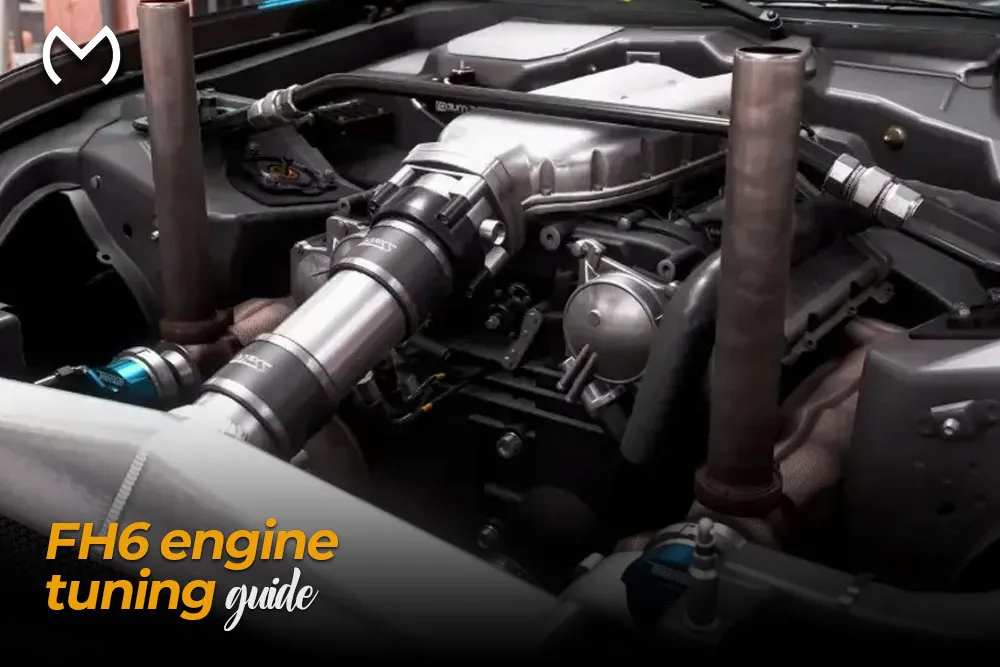
The highest horsepower figure does not always produce the fastest car. This Forza Horizon 6 engine tuning guide focuses on usable power that improves acceleration without overwhelming the tires or making the car difficult to control.
Upgrade the original engine first, choose aspiration around the required power delivery, and consider a swap only when it solves a clear weakness.
Build Power Without Ruining the Balance
Engine upgrades affect more than top speed. Added torque can increase wheelspin, change shift points and consume Performance Index that may be more valuable elsewhere.
A balanced approach is:
- Improve the stock engine gradually.
- Test whether the car can use the extra power.
- Add aspiration when it suits the build.
- Compare engine swaps only after reaching the stock motor’s limit.
Power delivery should also suit the driving style. Cars built around grip-focused or drift-focused tuning need different throttle response and torque characteristics.
Upgrade the Original Engine First
The stock engine often provides the best combination of weight, predictable response and PI efficiency.
Intake, exhaust and fuel-system parts can add manageable power. Camshaft, displacement and internal upgrades usually provide larger gains, but their PI cost can rise quickly.
A lighter flywheel improves engine response by allowing RPM to rise and fall faster. This can help on technical routes, though it does not replace a meaningful power increase.
Stop adding power when full throttle regularly causes wheelspin through important corner exits. At that point, tires, gearing or differential changes may improve race times more.
Choose the Right Aspiration
Aspiration changes how and when torque reaches the wheels.
Turbocharger
A turbo normally offers strong peak power and considerable upgrade potential. It suits cars that remain inside the effective RPM range.
The drawback is a more noticeable surge when boost arrives, which can make light RWD cars harder to control.
Positive-Displacement Supercharger
This option provides immediate low-RPM torque and sharp throttle response. It works well when the car needs strong acceleration without waiting for boost.
That instant torque may be difficult to use on dirt or in the lower gears.
Centrifugal Supercharger
A centrifugal setup builds power progressively as RPM increases. It can feel smoother than a torque-heavy option while still improving high-speed acceleration.
For a visual explanation of how engine choices interact with the complete setup, watch Learn to Tune in Under 15 Minutes.
Swap the Engine Only When Needed
An engine swap can change horsepower, torque, weight, aspiration options and upgrade potential.
The official FH6 customization overview confirms that supported kei cars can even use motorcycle engine swaps, showing why available engines and build potential differ between vehicles.
Consider a swap when it offers:
- A better power-to-weight ratio
- More useful power within the target class
- A smoother or stronger power curve
- Upgrade options unavailable on the original motor
Keep the stock engine when the swap consumes too much PI, adds unwanted weight or makes the throttle response harder to manage.
Match Power to the Event
Road builds benefit from smooth mid-range torque and clean corner exits. A balanced car is usually quicker than one that spins its tires whenever full throttle is applied.
Dirt builds need progressive delivery because sudden torque can break traction on loose surfaces.
Drag cars can use higher output, but the engine must still work with the launch and gearing. The straight-line power setup explains how those areas connect.
Drift builds need enough torque to maintain wheelspin without making throttle inputs unpredictable. Consistent power through drift transitions also depends on tire grip and gear choice.
Diagnose the Problem Before Adding Power
- Wheelspin through several gears: Improve traction or reduce torque.
- Weak pull at high RPM: Add top-end power or adjust gearing.
- Sudden oversteer when boost arrives: Use smoother delivery.
- The car feels heavy after a swap: Return to the original engine.
- PI rises faster than performance: Remove the least efficient part.
- Dirt traction is inconsistent: Prioritize progressive torque.
Testing different engines, aspiration systems and class-specific builds can require significant CR. Extra Forza Horizon 6 Credits can make it easier to compare options without dismantling a finished car.
Build stronger engine setups with these FH6 services:

Test the Engine Build
Use one route with a standing launch, slow corner exit and long straight. Complete two baseline runs, then add one upgrade group.
Compare wheelspin, acceleration, shift points and total route time. Keep an upgrade only when it improves the complete run.
Once the car delivers consistent performance, you can share the completed tune with the exact engine and aspiration combination.
Final Takeaway
Improve the original engine first, choose aspiration around the required power curve and use an engine swap only when it solves a genuine limitation.
Usable power will normally produce better results than chasing the largest horsepower number.
FAQs
Is an Engine Swap Always Better?
No. It may add power while increasing weight, consuming PI or making the car harder to control.
Which Aspiration Option Is Best?
Turbocharging favors peak power, positive-displacement supercharging adds immediate torque, and centrifugal supercharging provides progressive delivery.
Why Does My Car Spin After an Upgrade?
The added torque may exceed the available tire grip. Check tires, gearing and differential settings first.
Should Dirt Cars Use Less Power?
Not necessarily. They usually need smoother torque delivery rather than a lower horsepower figure.
What Is the Most PI-Efficient Upgrade?
It depends on the car. Keep parts that improve full-run performance for the smallest PI increase.