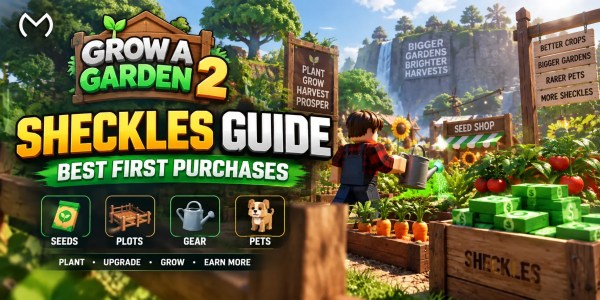




























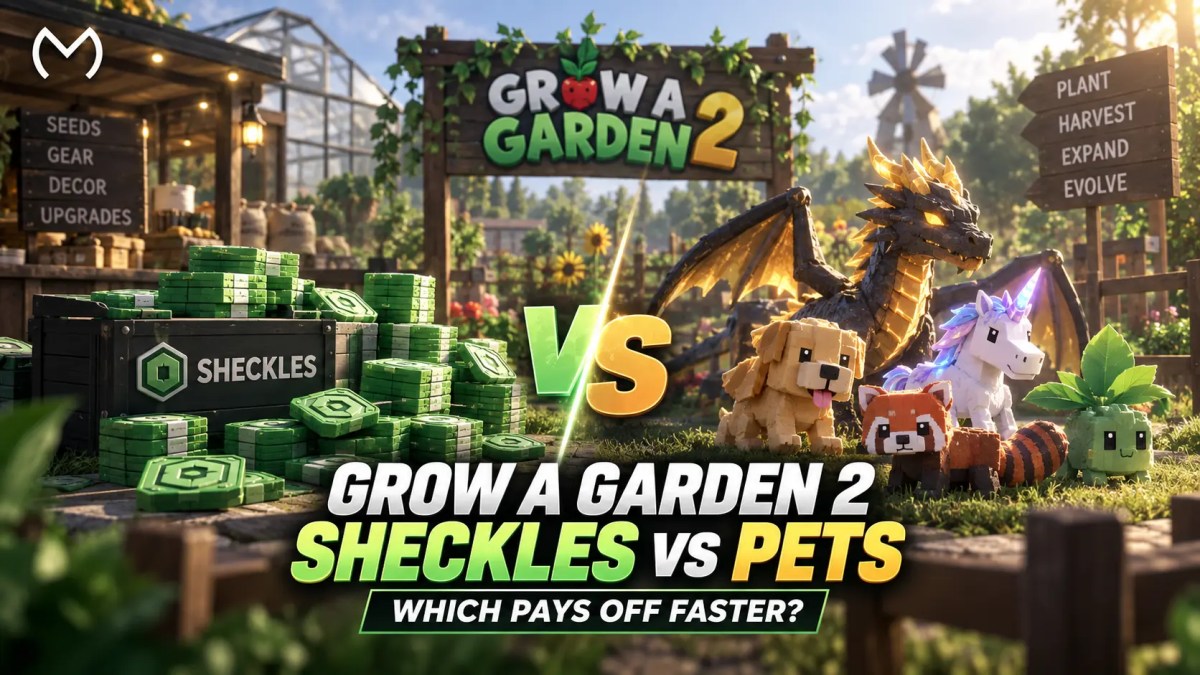
The right answer to Grow a Garden 2 Sheckles vs pets depends on what is slowing your garden right now. Sheckles remove purchasing bottlenecks immediately. Pets improve a specific part of the farm repeatedly, so their value grows only when the system around them is already productive.
That difference matters because Grow a Garden 2 is built around a reinvestment loop: buy seeds, grow crops, sell the harvest, and use the return to improve the next cycle. buy seeds, harvest crops, and reinvest the Sheckles
So do not ask, “Which item is stronger?” Ask, “Which one removes my current bottleneck?”
Start With the Bottleneck, Not the Rarity
A rare pet can look like the obvious upgrade, but rarity is not the same as progression value.
If you are still short on seeds, shop purchases, expansion money, or enough cash to react when a useful pet appears, Sheckles can improve several systems at once.
If those basics are already covered, another pile of currency may change very little. A pet that increases growth, supports mutations, protects expensive crops, or improves stealing can then affect every future cycle.
Use this as the starting test:
| Your Current Problem | What Solves It Faster? | Reason |
| Cannot afford better seeds or upgrades | Sheckles | Removes the purchase barrier immediately |
| Useful pet appears but balance is too low | Sheckles | Keeps buying power available |
| Crops grow too slowly | Growth pet | Improves repeated harvest cycles |
| Valuable crops keep getting stolen | Defense pet | Protects value already created |
| Strong farm needs better mutations | Mutation pet | Adds upside to high-value crops |
| You mainly want rare trade inventory | Rare pet | Scarcity can matter more than farming output |
This is also why a single fixed “pets are better” or “Sheckles are better” answer does not work.
If you are deciding which side of the progression grind to skip, the current Grow a Garden 2 items and Pets selection includes Sheckles, Pets, and Seeds, so the purchase can match the actual bottleneck rather than forcing one category. MitchCactus currently lists all three categories on the live GAG2 page.
Sheckles Have Their Highest Value Before Your Farm Is Stable
Sheckles are strongest when every purchase still creates another opportunity.
A new garden needs money for better seeds. Better seeds create stronger harvests. Stronger harvests rebuild the Sheckle balance faster. Currency can also be held instead of spent, which matters because pets can appear with limited purchase windows.
This gives Sheckles something pets do not have: option value.
You can decide later whether the same balance goes into:
- seeds,
- a newly spawned pet,
- tools or other upgrades,
- more productive farm capacity,
- or another purchase that appears after an update.
That flexibility is particularly important early because spending too much on one specialist pet can leave the rest of the farm underfunded.
If seeds are the real problem rather than cash itself, use the faster seed progression routes before deciding that you simply need a larger currency reserve.
The Pet Break-Even Point Comes Later
A pet starts beating more currency when you no longer need Sheckles to fix basic farm problems.
At that stage, you are buying repeatable output, not one-time spending power.
A Deer, for example, currently helps plants grow 10% faster, while the Golden Dragonfly and Unicorn improve your chances of getting Gold and Rainbow crop mutations respectively. The value of those passives increases when they are supporting crops worth improving in the first place.
The key is to connect the passive to something valuable enough to benefit from it.
A growth pet on weak crops is still improving weak crops.
A mutation pet on a mature farm with expensive harvests has much more upside.
That creates a simple progression rule:
Build the engine with Sheckles. Improve the engine with pets.
Not Every Expensive Pet Improves Progress Equally
Current pet guides tend to rank companions by overall strength, but that can hide the difference between good pet and good purchase for your account.
Think in roles.
Farming Pets
Choose these when production speed or crop generation is the bottleneck.
Their value comes from producing more opportunities over time, which makes them stronger after your normal planting loop is already profitable.
Mutation Pets
These belong later in progression.
Gold, Rainbow, and other high-value crop mutations matter more when the underlying crop is already worth improving. These crop mutations should not be confused with pet variants or pet mutations, which use their own separate system.
Paying heavily for a mutation-focused pet before you can consistently grow valuable crops wastes much of its potential.
Defense Pets
Night stealing changes the calculation because losing finished crops destroys value that has already been created. The game’s day/night structure makes protection more important as your garden becomes worth raiding.
Stealing and Utility Pets
These can be excellent for a particular playstyle but should not be treated as automatic income upgrades.
Buy the ability because you will use it, not because the pet sits high on a rarity list.
Currency Can Be the Better Way to Get a Pet
Sheckles and pets are not completely separate choices.
Many main-world pets are themselves purchased using Sheckles when they appear. Current pet data lists examples ranging from cheaper utility companions to multimillion-Sheckle late-game pets.
That means keeping currency ready can sometimes be the best pet strategy.
Instead of buying one pet immediately, you preserve the ability to react to the right spawn.
This is especially useful for returning players who already understand their farm but do not need one exact rare companion.
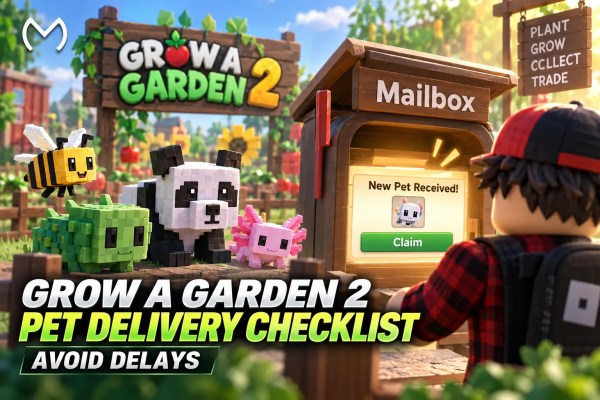
For players whose main issue is keeping enough purchasing power available, the current Grow a Garden 2 Sheckles option lists under-20-minute delivery. The service currently describes delivery through gifted sellable fruits and mailbox-based in-game delivery rather than requiring account credentials.
Trade Value Can Make the “Wrong” Progression Pet Valuable
Progression value and trade value should be judged separately.
A pet can have mediocre value for your own garden yet still be desirable because of:
- rarity,
- limited availability,
- variant,
- demand,
- or difficulty replacing it.
The opposite can also happen. A cheaper farming pet may improve your Sheckles-per-hour more than a much rarer collector pet.
Do not spend a progression budget based only on a trading tier list.
If you buy a rare pet, know which goal you are paying for:
Farm output: judge the passive.
Trading: judge scarcity and demand.
Collection: judge how difficult the exact pet or variant is to obtain again.
Current pet data also distinguishes pet variants and mutations from crop mutations, so the value of a rare pet version should be judged separately from the crop effects produced by mutation-focused pets.
Fall Harvest Changes the Comparison Completely
This is the biggest current caveat that a generic Sheckles-vs-pets answer can miss.
Fall Harvest uses Leaves as its local event currency, and normal Sheckles are paused for purchases inside that world. However, that does not make your main-world Sheckle balance irrelevant: Magic Mail, which is used to move eligible Fall Harvest items back to Garden Valley, is purchased with Sheckles from the main-world economy.
So if your goal is simply buying Fall Harvest seeds or pets inside the event world, more Sheckles do not replace the Leaves you need there. But keeping a Sheckle reserve can still matter when you plan to transfer valuable event items back to your main garden.
The current Fall Harvest progression breakdown is more useful in that situation because it separates the event economy from normal Garden Valley progression.
This is a good example of why goal first, purchase second is the safer rule.
Where Your Progression Should Shift From Sheckles to Pets
Instead of classifying players only as “new” or “advanced,” watch for these three transitions.
Stage 1: Your Garden Still Needs Capital
Prioritize Sheckles.
You should be able to buy useful seeds and keep enough reserve that one normal purchase does not empty your balance.
Pets at this point should be inexpensive and directly useful, not prestige purchases.
Stage 2: Your Farm Pays for Normal Purchases
Start moving spending toward pets.
At this stage, adding another currency stack has diminishing value because your farm already replaces ordinary spending. A growth, protection, or utility pet can now improve future cycles instead.
Stage 3: Your Profit Comes From Optimization
Pets usually become the stronger progression investment.
Mutation support, specialized farming passives, defense, and rare trade assets matter more because the question is no longer “Can I afford seeds?”
It is “How do I make an already valuable garden more efficient?”
If that is your stage, the current Grow a Garden 2 pet catalog includes multiple available pets, with the current GAG2 catalog advertising delivery within 20 minutes.
The Purchase Test That Matters Most
Before buying either one, estimate what changes after the purchase.
Choose Sheckles when the money will unlock two or more useful next steps.
Choose a pet when its passive directly improves an activity you already perform often.
Choose neither yet when you cannot explain what the purchase changes.
That final rule prevents the most expensive mistake in this comparison: spending simply because one option looks rarer.
Check out some of our most popular Boosting services:

Conclusion
Sheckles usually improve progress faster at the beginning because they keep the entire economy moving. They let you react to seeds, pets, and other purchases instead of committing all your value to one passive.
Pets become stronger once the farm no longer depends on every Sheckle. At that point, repeated growth, mutation, defense, or utility benefits can create more long-term value than simply increasing the wallet balance.
The switch should happen when your farm moves from needing capital to needing optimization.
That is the real answer to Grow a Garden 2 Sheckles vs pets: buy the resource that removes the next bottleneck, not the one with the more impressive rarity label.
Frequently Asked Questions
Are Sheckles or pets better for beginners in Grow a Garden 2?
Sheckles are usually more useful early because they can fund several progression needs. A beginner pet is worth buying when its cost does not prevent you from maintaining seeds and other essential purchases.
When should I start spending more on pets?
Start prioritizing pets once your normal farm reliably covers seed and upgrade costs. That is when passive bonuses can improve an already functional economy instead of competing with basic progression.
Which Grow a Garden 2 pets help make more Sheckles?
Growth and mutation-focused pets can improve income indirectly by increasing harvest frequency or the value of crops. Deer currently improves plant growth speed, while pets such as Golden Dragonfly and Unicorn support Gold and Rainbow mutation chances.
Is a rare pet always better than buying Sheckles?
No. Rarity can increase collection or trade demand, but it does not guarantee that the pet improves your current farm more than flexible currency would.
Do Sheckles work in Fall Harvest?
Fall Harvest purchases and progression use Leaves, with normal Sheckles paused inside the event world. Sheckles still matter for cross-world systems such as buying Magic Mail to move eligible event items back to Garden Valley.