




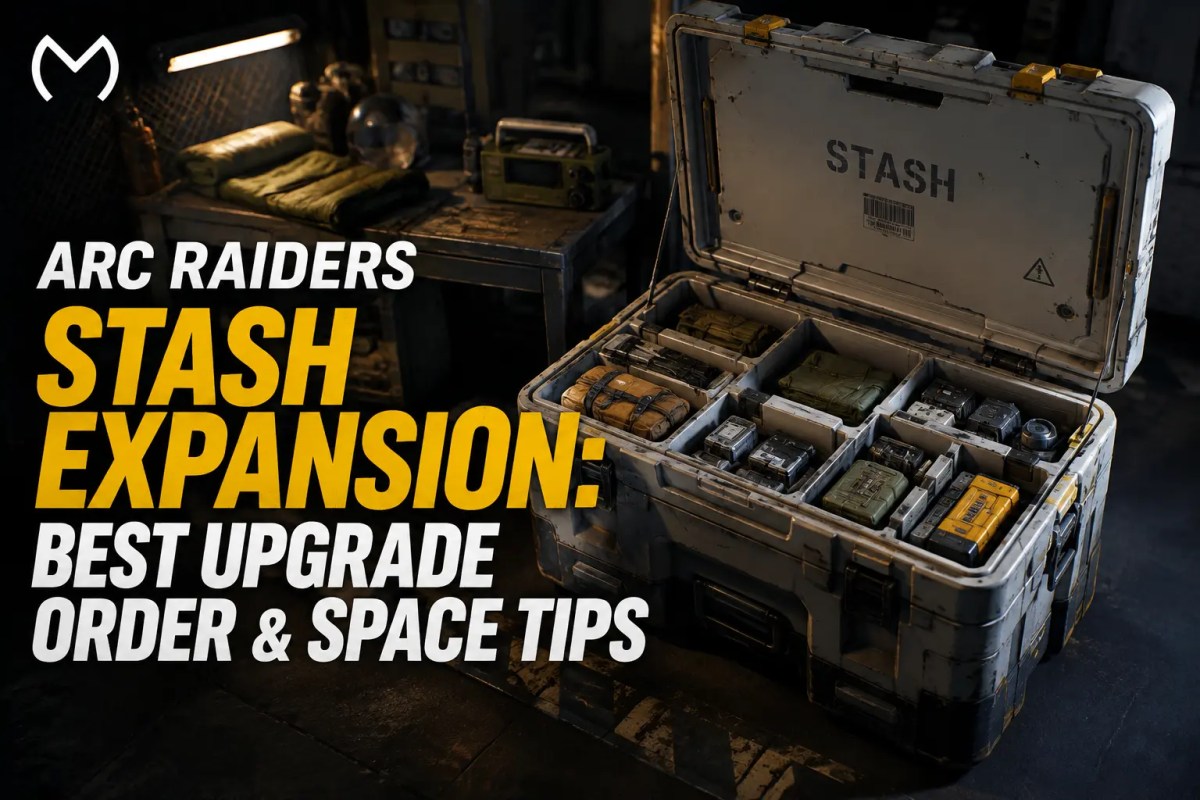
Running out of stash space forces bad decisions. You sell a workshop material, recycle a quest item, or break up a ready loadout just to make room for the next extraction. The best ARC Raiders stash expansion order is to buy the cheap early upgrades quickly, stop around 208 slots if your Coin income is still unstable, then push toward 280 when crafting, Projects, and saved raid kits create real pressure.
The ordinary Stash starts at 64 slots. Each Coin upgrade adds 24 slots, with Level 10 reaching 280. The full path costs 575,000 Coins, and most of that cost sits in the final three upgrades.
ARC Raiders Stash Upgrade Costs and Best Timing
The early Stash levels give much more space for relatively little Coin investment, while the final upgrades become progressively more expensive. Use the table below to decide when the extra capacity is worth buying and when keeping a larger Coin reserve makes more sense.
| Stash Level | Total Slots | Upgrade Cost | Total Spent | Recommended Timing |
| 1 | 64 | Starting capacity | 0 | First raids |
| 2 | 88 | 5,000 | 5,000 | Buy early |
| 3 | 112 | 10,000 | 15,000 | Buy early |
| 4 | 136 | 15,000 | 30,000 | Early target |
| 5 | 160 | 25,000 | 55,000 | Workshop stock grows |
| 6 | 184 | 40,000 | 95,000 | Mid game |
| 7 | 208 | 60,000 | 155,000 | Strong breakpoint |
| 8 | 232 | 90,000 | 245,000 | Stable Coin income |
| 9 | 256 | 130,000 | 375,000 | Heavy Project storage |
| 10 | 280 | 200,000 | 575,000 | Endgame convenience |
Levels 2 through 4 are easy value because 30,000 Coins takes you from 64 to 136 slots. Level 7 is a useful stopping point: 155,000 total Coins buys 208 slots without committing to the steep end of the curve.
Levels 8 through 10 cost another 420,000 Coins. Buy them when storage is genuinely limiting progression, not simply because the next upgrade is available.
Build Space Around Your Current Goal
More slots only help if the stash has a purpose.
Crafting and Projects
Keep the exact materials needed for your next workshop upgrade plus a small reserve for gear you craft regularly. Once the upgrade is finished, reduce that stock instead of hoarding the same amount forever.
Do the same with active Project items. Reserve them before selling duplicates or spending them on optional crafting.
If you would rather skip the full Coin grind, you can explore ARC Raiders Stash Expansion boost once storage farming starts taking time away from the raids or Projects you actually want to play.
Use Three Loadout Bins
Keep two or three repeatable loadout types instead of a weapon collection:
- Budget bin for farming and quest runs
- Main bin for your regular weapons, shields, healing, and utility
- Heavy bin for difficult ARC fights or contested objectives
These are manual sections in your stash, not a separate in game container feature. The goal is to equip quickly without digging through unrelated loot.
Keep, Sell, or Recycle
Use one question after every extraction: does this item serve a current quest, Project, workshop upgrade, or regular loadout?
Keep it if the answer is yes.
Sell it when it has no current progression use and you need Coins for upgrades or gear.
Recycle it when the resulting materials are more useful than the item itself.
Do not sell unfamiliar materials just because they look like junk. ARC Raiders uses ordinary looking items across quests, Scrappy, workshops, and Projects. The ARC Raiders selling guide helps separate useful stock from loot that can become Coins, while the recycling guide is useful before breaking down questionable items.
The 60 Second Post Raid Routine
- Merge partial stacks.
- Move quest, Project, and workshop items into one visible area.
- Refill your active loadout bins.
- Equip useful attachments instead of storing loose duplicates.
- Sell valuables with no current progression job.
- Recycle surplus items only after checking their use.
- Leave several empty slots for the next extraction.
This still matters at 280 slots. More space delays clutter, but it does not fix hoarding.
What Comes After the Normal 280 Slot Cap?
The Coin upgrade path is not the only source of storage.
Expedition completions add 12 permanent stash slots per completed Expedition. The Fourth Expedition brought the cumulative permanent Expedition bonus to 48 extra slots, while completing the fifth adds another 12 and brings the permanent Expedition stash bonus to its 60-slot cap.
This permanent stash reward is separate from the Expedition system used to award bonus Skill Points. Stash value has been used for Skill Point progression and catch-up requirements, but it does not replace the fixed +12 permanent stash-space reward earned for each completed Expedition.
Level 25 Raiders can also trade with Ermal, the Nomadic Envoy. His current Stash Expansion service offers two separate +12-slot expansions. The first requires 200,000 item value in eligible high-tier ARC parts, while the second requires 400,000 item value.
There is one important catch: Ermal’s extra Stash space resets when you depart on an Expedition. The official Nomadic Envoy update confirms that his expanded Stash space is a current-cycle benefit rather than permanent Expedition progression.
Do not confuse this with Ermal’s Expedition Vault. The Vault is a separate service designed to carry selected items across an Expedition, while the Stash Expansion simply adds temporary storage capacity to your current Raider.
Farming Time vs the Boost Option
Self farming lets stash upgrades happen alongside quests, crafting, and normal loot runs. There is no fixed verified number of hours because the grind changes with extraction success, loot value, deaths, and your starting Coin balance.
What is fixed is the cost. Reaching Level 10 from the base costs 575,000 Coins, with 420,000 tied to the final three upgrades.
The current MitchCactus Stash Expansion service supports progression up to Level 10 and 280 ordinary slots. Its listed delivery method uses manual play on the account, with an estimated one to three days depending on the number of levels ordered.
Farm naturally when the Coin grind fits your normal progression. Consider the dedicated Stash Expansion service when storage is blocking current goals and the saved farming time matters more than doing the grind yourself.
Need more storage without the full grind? Explore these ARC Raiders options

Conclusion
Upgrade your ARC Raiders stash in stages. Push the cheap upgrades early, use 208 slots as a sensible midpoint, then pay for 232, 256, and 280 when storage pressure is costing useful loot or slowing projects.
Keep goal based materials, maintain a few repeatable loadout bins, clear dead inventory after every raid, and know the difference between ordinary Stash upgrades, permanent Expedition space, and Ermal’s temporary expansion. More slots help, but good organization keeps those slots useful.
Frequently Asked Questions
What is the maximum normal stash size in ARC Raiders?
The ordinary Coin upgrade path reaches Stash Level 10 at 280 slots. Expedition bonuses and Ermal can add space beyond that normal cap.
How much does it cost to max the ARC Raiders stash?
Upgrading from 64 to 280 ordinary slots costs 575,000 Coins in total.
What stash level should I upgrade to first?
Level 4 at 136 slots is a practical early target for 30,000 total Coins. Level 7 at 208 slots is a strong midpoint before the expensive final three upgrades.
Does Stash Expansion reset after an Expedition?
Standard Coin-purchased Stash Upgrade Progress resets when your Raider departs on an Expedition. Permanent bonus stash slots earned from completed Expeditions carry forward, while the temporary +12-slot expansions bartered from Ermal also reset on departure.
What should I sell when my stash is full?
Sell items that are not needed for a current quest, Project, workshop upgrade, or regular loadout. Check unfamiliar materials before selling or recycling them.